Modern Mathematics, formulas + CAT PYQs
Permutations & Combinations, Probability, Set Theory (Venn diagrams), Sequences & Series and assorted "logic-counting" problems. A high-yield, formula-light area where careful case-work beats memorisation, perfect for a sales-trained, reasoning-first approach.
Formula & Concept Sheet
A-to-Z. Everything you need for this chapter, distilled.
- In plain English: when steps happen one after another you multiply; when you pick just one of several separate options you add.
- Product (AND): if a job has m ways for step 1 and n ways for step 2 done together, total = m × n.
- Sum (OR): if an action has m ways and a mutually-exclusive action has n ways, choose one in m + n ways.
- e.g. 3 shirts AND 2 trousers → 3 × 2 = 6 outfits; but "a shirt OR a trouser" → 3 + 2 = 5 single items.
- In plain English: count the ways to line up r things in a row out of n, where swapping the order makes a new arrangement.
- Arrangements of r out of n distinct things.
- n! = n × (n−1) × … × 2 × 1 ; 0! = 1.
- e.g. gold/silver/bronze from 5 runners: ⁵P₃ = 5 × 4 × 3 = 60.
- In plain English: count the ways to pick a group of r things out of n when the order you pick them in does not matter.
- Selections of r out of n distinct things.
- Symmetry: choosing r = leaving out (n−r).
- e.g. a team of 2 from 5 people: ⁵C₂ = (5 × 4)/(2 × 1) = 10.
- In plain English: each item is either "in" or "out," so the total number of possible selections (including picking nothing) is 2 multiplied by itself n times.
- Total subsets of an n-element set (incl. empty & full).
- "Choose some-or-none" of n distinct items = 2ⁿ.
- e.g. toppings from 3 choices: 2³ = 8 possible orders (incl. a plain pizza with none).
- In plain English: when some items are identical, swapping them changes nothing, so you shrink the plain n! by dividing out those wasted swaps.
- n things where p are alike of one kind, q of another, r of a third.
- Divide n! by the factorials of each repeated group.
- e.g. arrangements of the letters of "LEVEL" (5 letters, L×2, E×2): 5!/(2! 2!) = 120/4 = 30.
- In plain English: for each type you decide "how many to take" (0 up to all of them), multiply those choices, then knock off the one case where you took nothing.
- p of one type, q of a second, r of a third, … (alike within a type).
- Take any number (incl. none) of each, then subtract the all-empty case.
- e.g. select some fruit from 2 alike apples & 3 alike oranges: (2+1)(3+1) − 1 = 12 − 1 = 11 ways.
- In plain English: around a circle there is no "first seat," so rotating everyone gives the same arrangement, fix one person and arrange the rest in a line.
- Fix one person to kill rotational duplicates.
- If clockwise = anticlockwise (e.g. a necklace), divide by 2.
- e.g. 5 people at a round table: (5 − 1)! = 4! = 24 ways.
- In plain English: choosing who goes in the first group automatically fixes the rest; if the groups have no labels and are the same size, swapping the two groups is a duplicate so divide by 2.
- Split (m + n) things into two labelled groups of m and n.
- If the two groups are equal (m = n), divide by 2! for identical groups.
- e.g. split 6 people into groups of 4 and 2: 6!/(4! 2!) = 720/48 = 15.
- In plain English: line up the n identical items as "stars" and slot in (r − 1) dividers ("bars") to split them among the r people, count where the bars go.
- Distribute n identical items among r persons, each may get any number (incl. 0).
- "Stars & bars." For "each gets ≥ 1", first give one to each then apply the formula on what remains.
- e.g. give 5 identical chocolates to 3 kids (any can get 0): (5 + 3 − 1)C(3 − 1) = ⁷C₂ = 21.
- In plain English: a shortest path is just a sequence of "rights" and "ups"; count how many ways to order those moves.
- To go across a grid using only two directions (m of one, n of the other).
- Equivalent to arranging m + n moves of two kinds.
- e.g. corner to corner of a 2×3 block (2 ups, 3 rights): (2 + 3)!/(2! 3!) = 120/12 = 10 paths.
- In plain English: every term looks like aˣbʸcᶻ with x+y+z = n; counting the distinct terms is the same as counting whole-number ways to split n among three slots.
- Number of terms in (a + b + c)ⁿ = non-negative integer solutions of a + b + c = n.
- e.g. terms in (a + b + c)²: (2 + 2)C2 = ⁴C₂ = 6 (namely a², b², c², ab, bc, ca).
- In plain English: probability is just "how many ways it can happen" divided by "how many ways anything can happen," assuming every outcome is equally likely.
- Assumes equally likely outcomes; always between 0 and 1.
- e.g. rolling an even number on a die: 3 favourable / 6 total = 1/2.
- In plain English: odds pit the "wins" directly against the "losses" as a ratio, instead of dividing wins by the total like probability does.
- Compares favourable to unfavourable cases (not to the total).
- e.g. for rolling a 6 on a die: odds in favour = 1 : 5 (one good face, five bad).
- In plain English: for "A or B," add the two chances but subtract the part you counted twice (where both happen).
- General OR rule (subtract the overlap).
- Mutually exclusive ⇒ P(A ∩ B) = 0.
- e.g. a card that is a King or a Heart: 4/52 + 13/52 − 1/52 = 16/52 = 4/13.
- In plain English: for "A and B" of unrelated events, multiply their chances; if one affects the other, use the conditional version.
- For independent events the AND probability multiplies.
- Conditional probability links them when not independent.
- e.g. two heads in two coin tosses: 1/2 × 1/2 = 1/4.
- In plain English: weight each possible payoff by how likely it is, then add them up, what you'd average if you repeated it forever.
- The long-run average of a random quantity.
- Sum of (each value × its probability).
- e.g. win ₹10 on heads, ₹0 on tails: E = 10 × ½ + 0 × ½ = ₹5.
- In plain English: sets are just collections; "union" pools everyone, "intersection" keeps only the shared members, "difference" removes the overlap.
- Union ∪ = in A or B (or both); Intersection ∩ = in both.
- Difference A − B = in A but not B; Complement A′ = not in A.
- Null set ⌀ is a subset of every set; power set of n elements has 2ⁿ subsets.
- e.g. A = {1,2,3}, B = {2,3,4}: A∪B = {1,2,3,4}, A∩B = {2,3}, A−B = {1}.
- In plain English: people who do both got counted in each circle, so add the two totals and subtract that overlap once.
- Add the two sets, subtract the double-counted overlap.
- e.g. 30 like tea, 25 like coffee, 10 like both → total who like at least one = 30 + 25 − 10 = 45.
- In plain English: add all three circles, take out each pairwise overlap (over-subtracting the centre), then add the triple-overlap back once to fix it.
- Inclusion-exclusion: add singles, subtract pairs, add back the triple.
- e.g. |A|=|B|=|C|=10, each pair shares 3, all three share 1 → union = 30 − 9 + 1 = 22.
- In plain English: someone in exactly two sets is counted twice in the size-total, someone in all three is counted thrice, these two equations untangle the layers fast.
- Let x = exactly-one, y = exactly-two, z = exactly-three (all three).
- Total in at least one set = x + y + z; the "repeated total" of memberships = sum of the set sizes.
- e.g. sizes sum to 50, at least-one T = 30, all-three z = 5 → 30 + y + 2(5) = 50 → exactly-two y = 10.
- In plain English: an AP adds the same fixed step each time; the sum is just the average of the first and last term, times how many terms.
- Constant common difference d; nth term and sum below.
- e.g. 2, 5, 8, 11, 14 (a=2, d=3): 5th term = 2 + 4×3 = 14; sum = 5/2 × (2 + 14) = 40.
- In plain English: a GP multiplies by the same fixed ratio each time; if that ratio is a fraction the terms shrink and the infinite sum settles on a finite value.
- Constant ratio r; sum of a finite GP and (for |r|<1) an infinite GP.
- e.g. 1 + ½ + ¼ + ⅛ + … (a=1, r=½): S∞ = 1/(1 − ½) = 2.
- In plain English: handy closed forms so you never add 1+2+…+n by hand; remember the cube-sum equals the square of the plain sum.
- Sum of first n natural numbers, their squares and cubes.
- Note: Σn³ = (Σn)².
- e.g. 1+2+…+10 = 10×11/2 = 55; and 1³+2³+…+10³ = 55² = 3025.
- In plain English: the three means rank AM ≥ GM ≥ HM; and any "everyone meets everyone once" count (handshakes, matches, lines) is just nC2 pairs.
- AM-GM-HM for two positives a, b; AM ≥ GM ≥ HM.
- Pairs from n people (handshakes / matches / lines / diagonals).
- e.g. 6 people each shake hands once: ⁶C₂ = 15 handshakes. For a, b = 4, 9: AM = 6.5, GM = 6.
Permutations & Combinations · 60 CAT PYQs
Permutations & Combinations
Counting, arrangements, selections, digit problems and logic-counting, the bulk of Modern Maths PYQs.
CAT 1995
A, B, C and D are four towns, any three of which are non-collinear. Then the number of ways to construct three roads each joining a pair of towns so that the roads do not form a triangle is:
- (1) 7
- (2) 8
- (3) 9
- (4) 16
Show solution
CAT 1997
In how many ways can eight directors, the vice-chairman and chairman of a firm be seated at a round table, if the chairman has to sit between the vice-chairman and a director?
- (1) 9! × 2
- (2) 2 × 8!
- (3) 2 × 7!
- (4) None of these
Show solution
CAT 1998
How many numbers can be formed from 1, 2, 3, 4, 5, without repetition, when the digit at the unit's place must be greater than that in the ten's place?
- (1) 54
- (2) 60
- (3) 17
- (4) 2 × 4!
Show solution
How many five-digit numbers can be formed using the digits 2, 3, 8, 7, 5 exactly once such that the number is divisible by 125?
- (1) 0
- (2) 1
- (3) 4
- (4) 3
Show solution
CAT 1999
Ten points are marked on a straight-line and 11 points are marked on another straight-line. How many triangles can be constructed with vertices from among the above points?
- (1) 495
- (2) 550
- (3) 1045
- (4) 2475
Show solution
For a scholarship, at the most n candidates out of 2n + 1 can be selected. If the number of different ways of selection of at least one candidate is 63, the maximum number of candidates that can be selected for the scholarship is
- (1) 3
- (2) 4
- (3) 6
- (4) 5
Show solution
CAT 2000
One red flag, three white flags and two blue flags are arranged in a line such that: (i) No two adjacent flags are of the same colour (ii) The flags at the two ends of the line are of different colours. In how many different ways can the flags be arranged?
- (1) 6
- (2) 4
- (3) 10
- (4) 2
Show solution
Sam has forgotten his friend's seven-digit telephone number. He remembers the following: the first three digits are either 635 or 674, the number is odd, and the number 9 appears once. If Sam were to use a trial and error process to reach his friend, what is the minimum number of trials he has to make before he can be certain to succeed?
- (1) 10,000
- (2) 2,430
- (3) 3,402
- (4) 3,006
Show solution
CAT 2001
Let n be the number of different 5 digit numbers, divisible by 4 with the digits 1, 2, 3, 4, 5 and 6, no digit being repeated in the numbers. What is the value of n?
- (1) 144
- (2) 168
- (3) 192
- (4) None of these
Show solution
CAT 2002
n₁, n₂, n₃ … n₁₀ are 10 numbers such that n₁ > 0 and the numbers are given in ascending order. How many triplets can be formed using these numbers such that in each triplet, the first number is less than the second number, and the second number is less than the third number?
- (1) 109
- (2) 27
- (3) 36
- (4) None of these
Show solution
How many numbers between 0 and one million can be formed using 0, 7 and 8?
- (1) 486
- (2) 1086
- (3) 728
- (4) None of these
Show solution
In how many ways, we can choose a black and a white square on a chess board such that the two are not in the same row or column?
- (1) 32
- (2) 96
- (3) 24
- (4) None of these
Show solution
There are 11 alphabets A, H, I, M, Q, T, U, V, W, X and Y. They are called symmetrical alphabets. The remaining alphabets are known as asymmetrical alphabets. How many four-lettered passwords can be formed by using symmetrical letters only? (repetitions not allowed)
- (1) 1086
- (2) 255
- (3) 7920
- (4) None of these
Show solution
How many three-lettered words can be formed such that at least one symmetrical letter is there?
- (1) 12870
- (2) 18330
- (3) 16420
- (4) None of these
Show solution
CAT 2003
How many three digit positive integers, with digits x, y and z in the hundred's, ten's and unit's place, respectively exist such that x < y, z < y and x ≠ 0?
- (1) 245
- (2) 285
- (3) 240
- (4) 320
Show solution
There are 6 boxes numbered 1, 2, …6. Each box is to be filled up either with a red or a green ball in such a way that at least 1 box contains a green ball and the boxes containing green balls are consecutively numbered. The total number of ways in which this can be done is
- (1) 5
- (2) 21
- (3) 33
- (4) 60
Show solution
In a certain examination paper, there are n questions. For j = 1, 2 …n, there are 2^(n−j) students who answered j or more questions wrongly. If the total number of wrong answers is 4095, then the value of n is___.
- (1) 12
- (2) 11
- (3) 10
- (4) 9
Show solution
A string of three English letters is formed as per the following rules: (a) The first letter is any vowel. (b) The second letter is m, n or p. (c) If the second letter is m, then the third letter is any vowel which is different from the first letter. (d) If the second letter is n, then the third letter is e or u. (e) If the second letter is p, then the third letter is the same as the first letter. How many strings of letters can possibly be formed using the above rules?
- (1) 40
- (2) 45
- (3) 30
- (4) 35
Show solution
(Using the same rules as the previous question.) How many strings of letters can possibly be formed using the above rules such that the third letter of the string is e?
- (1) 8
- (2) 9
- (3) 10
- (4) 11
Show solution
There are 12 towns grouped into four zones with three towns per zone. It is intended to connect the towns with telephone lines such that every two towns are connected with three direct lines if they belong to the same zone, and with only one direct line otherwise. How many direct telephone lines are required?
- (1) 72
- (2) 90
- (3) 96
- (4) 144
Show solution
An intelligence agency forms a code of two distinct digits selected from 0, 1, 2, ..., 9 such that the first digit of the code is nonzero. The code, handwritten on a slip, can however potentially create confusion, when read upside down - for example, the code 91 may appear as 16. How many codes are there for which no such confusion can arise?
- (1) 80
- (2) 78
- (3) 71
- (4) 69
Show solution
CAT 2004
N person stand on the circumference of a circle at distinct points. Each possible pair of persons, not standing next to each other, sings a two-minute song one pair after the other. If the total time taken for singing is 28 minutes, what is N?
- (1) 5
- (2) 7
- (3) 9
- (4) None of these
Show solution
Suppose n is an integer such that the sum of the digits of n is 2, and 10¹⁰ < n < 10¹¹. The number of different values for n is:
- (1) 11
- (2) 10
- (3) 9
- (4) 8
Show solution
In the following figure, the lines represent one-way roads allowing travel only northwards or only westwards. Along how many distinct routes can a car reach point B from point A?
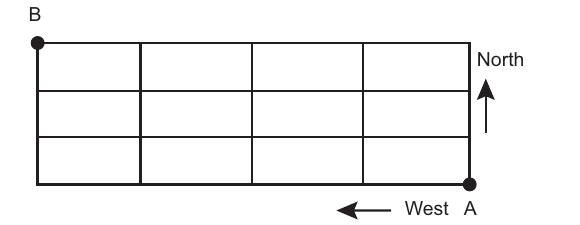
- (1) 15
- (2) 56
- (3) 120
- (4) 336
Show solution
A new flag is to be designed with six vertical stripes using some or all of the colours yellow, green, blue and red. Then, the number of ways this can be done such that no two adjacent stripes have the same colour is:
- (1) 12 × 81
- (2) 16 × 192
- (3) 20 × 125
- (4) 24 × 216
Show solution
CAT 2005
In a chess competition involving some boys and girls of a school, every student had to play exactly one game with every other student. It was found that in 45 games both the players were girls, and in 190 games both were boys. The number of games in which one player was a boy and the other was a girl is:
- (1) 200
- (2) 216
- (3) 235
- (4) 256
Show solution
Let S be the set of five digit numbers formed by the digits 1, 2, 3, 4 and 5, using each digit exactly once such that exactly two odd positions are occupied by odd digits. What is the sum of the digits in the rightmost position of the numbers in S?
- (1) 228
- (2) 216
- (3) 294
- (4) 192
Show solution
CAT 2006
There are 6 tasks and 6 persons. Task 1 cannot be assigned either to person 1 or to person 2; task 2 must be assigned to either person 3 or person 4. Every person is to be assigned one task. In how many ways can the assignment be done?
- (1) 144
- (2) 180
- (3) 192
- (4) 360
Show solution
CAT 2007
Let S be the set of all pairs (i, j) where 1 ≤ i ≤ j < n and n ≥ 4. Any two distinct members of S are called "friends" if they have one constituent of the pairs in common and "enemies" otherwise. For example, if n = 4, then S = {(1, 2), (1, 3), (1, 4), (2, 3), (2, 4), (3, 4)}. Here, (1, 2) and (1, 3) are friends, (1,2) and (2, 3) are also friends, but (1,4) and (2, 3) are enemies. For general n, how many enemies will each member of S have?
- (1) n − 3
- (2) ½(n² − 3n − 2)
- (3) 2n − 7
- (4) ½(n² − 5n + 6)
Show solution
For general n, consider any two members of S that are friends. How many other members of S will be common friends of both these members?
- (1) ½(n² − 5n + 8)
- (2) 2n − 6
- (3) ½ n(n − 3)
- (4) n − 2
Show solution
In a tournament, there are n teams T₁, T₂ ....., Tₙ with n > 5. Each team consists of k players, k > 3. The following pairs of teams have one player in common: T₁ & T₂, T₂ & T₃ ,......, Tₙ₋₁ & Tₙ, and Tₙ & T₁. No other pair of teams has any player in common. How many players are participating in the tournament, considering all the n teams together?
- (1) n(k − 1)
- (2) k(n − 1)
- (3) n(k − 2)
- (4) k(k − 2)
Show solution
CAT 2008
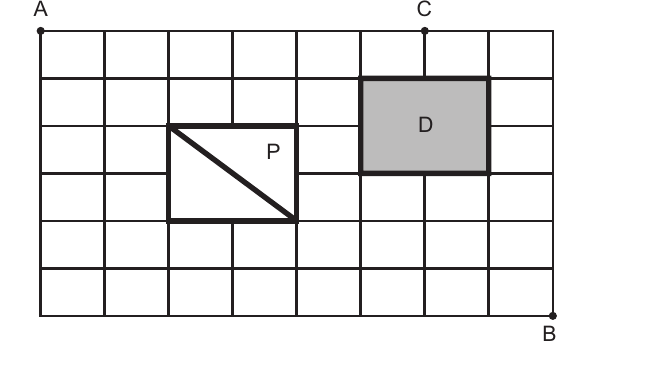
The figure below shows the plan of a town. The streets are at right angles to each other. A rectangular park (P) is situated inside the town with a diagonal road running through it. There is also a prohibited region (D) in the town. Neelam rides her bicycle from her house at A to her office at B, taking the shortest path. Then the number of possible shortest paths that she can choose is:
- (1) 60
- (2) 75
- (3) 45
- (4) 90
Show solution
(Same town plan as the previous question.) Neelam rides her bicycle from her house at A to her club at C, via B taking the shortest path. Then the number of possible shortest paths that she can choose is:
- (1) 1170
- (2) 630
- (3) 792
- (4) 1200
Show solution
The integers 1, 2, …, 40 are written on a blackboard. The following operation is then repeated 39 times: In each repetition, any two numbers, say a and b, currently on the blackboard are erased and a new number a + b − 1 is written. What will be the number left on the board at the end?
- (1) 820
- (2) 821
- (3) 781
- (4) 819
Show solution
How many integers, greater than 999 but not greater than 4000, can be formed with the digits 0, 1, 2, 3 and 4, if repetition of digits is allowed?
- (1) 499
- (2) 500
- (3) 375
- (4) 376
Show solution
What is the number of distinct terms in the expansion of (a + b + c)²⁰?
- (1) 231
- (2) 253
- (3) 242
- (4) 210
Show solution
Five horses, Red, White, Grey, Black and Spotted participated in a race. As per the rules of the race, the persons betting on the winning horse get four times the bet amount and those betting on the horse that came in the second get thrice the bet amount. Moreover, the bet amount is returned to those betting on the horse that came in third, and the rest lose the bet amount. Raju bets ₹3000, ₹2000, ₹1000 on Red, White and Black horses respectively and ends up with no profit and no loss. Which of the following cannot be true?
- (1) At least two horses finished before Spotted
- (2) Red finished last
- (3) There were three horses between Black and Spotted
- (4) There were three horses between White and Red
Show solution
(Same horse-race setup as the previous question.) Suppose, in addition, it is known that Grey came in fourth. Then which of the following cannot be true?
- (1) Spotted came in first
- (2) Red finished last
- (3) White came in second
- (4) Black came in second
Show solution
CAT 2017
Let AB, CD, EF, GH, and JK be five diameters of a circle with center at O. In how many ways can three points be chosen out of A, B, C, D, E, F, G, H, J, K, and Q so as to form a triangle?
Show solution
How many four digit numbers, which are divisible by 6, can be formed using the digits 0, 2, 3, 4, 6, such that no digit is used more than once and 0 does not occur in the left-most position?
Show solution
An elevator has a weight limit of 630 kg. It is carrying a group of people of whom the heaviest weighs 57 kg and the lightest weighs 53 kg. What is the maximum possible number of people in the group?
Show solution
The numbers 1, 2, ..., 9 are arranged in a 3 × 3 square grid in such a way that each number occurs once and the entries along each column, each row, and each of the two diagonals add up to the same value. If the top left and the top right entries of the grid are 6 and 2, respectively, then the bottom middle entry is:
Show solution
CAT 2018
How many two-digit numbers, with a non-zero digit in the units place, are there which are more than thrice the number formed by interchanging the positions of its digits?
Show solution
How many numbers with two or more digits can be formed with the digits 1, 2, 3, 4, 5, 6, 7, 8, 9, so that in every such number, each digit is used at most once and the digits appear in the ascending order?
Show solution
In a tournament, there are 43 junior level and 51 senior level participants. Each pair of juniors play one match. Each pair of seniors play one match. There is no junior versus senior match. The number of girl versus girl matches in junior level is 153, while the number of boy versus boy matches in senior level is 276. The number of matches a boy plays against a girl is:
Show solution
CAT 2020
How many 3-digit numbers are there, for which the product of their digits is more than 2 but less than 7?
Show solution
How many 4-digit numbers, each greater than 1000 and each having all four digits distinct, are there with 7 coming before 3?
Show solution
How many integers in the set {100, 101, 102, ..., 999} have at least one digit repeated?
Show solution
CAT 2021
How many three-digit numbers are greater than 100 and increase by 198 when the three digits are arranged in the reverse order?
Show solution
For a 4-digit number, the sum of its digits in the thousands, hundreds and tens places is 14, the sum of its digits in the hundreds, tens and units places is 15, and the tens place digit is 4 more than the units place digit. Then the highest possible 4-digit number satisfying the above conditions is
Show solution
The number of ways of distributing 15 identical balloons, 6 identical pencils and 3 identical erasers among 3 children, such that each child gets at least four balloons and one pencil, is
Show solution
A four-digit number is formed by using only the digits 1, 2 and 3 such that both 2 and 3 appear at least once. The number of all such four-digit numbers is
Show solution
CAT 2022
The number of ways of distributing 20 identical balloons among 4 children such that each child gets some balloons but no child gets an odd number of balloons is
Show solution
In an examination, there were 75 questions. 3 marks were awarded for each correct answer, 1 mark was deducted for each wrong answer and 1 mark was awarded for each unattempted question. Rayan scored a total of 97 marks in the examination. If the number of unattempted questions was higher than the number of attempted questions, then the maximum number of correct answers that Rayan could have given in the examination is:
Show solution
CAT 2024 & 2025, recent
Consider two sets A = {2, 3, 5, 7, 11, 13} and B = {1, 8, 27}. Let f be a function from A to B such that for every element b in B, there is at least one element a in A such that f(a) = b. Then, the total number of such functions f is
- (A) 537
- (B) 540
- (C) 667
- (D) 665
Show solution
The number of all positive integers up to 500 with non-repeating digits is
Show solution
A cafeteria offers 5 types of sandwiches. Moreover, for each type of sandwich, a customer can choose one of 4 breads and opt for either small or large sized sandwich. Optionally, the customer may also add up to 2 out of 6 available sauces. The number of different ways in which an order can be placed for a sandwich, is
- (A) 880
- (B) 840
- (C) 800
- (D) 600
Show solution
The number of distinct pairs of integers (x, y) satisfying the inequalities x > y ≥ 3 and x + y < 14 is
Show solution
If a, b, c and d are integers such that their sum is 46, then the minimum possible value of (a − b)² + (a − c)² + (a − d)² is
Show solution
Suppose a, b, c are three distinct natural numbers, such that 3ac = 8(a + b). Then, the smallest possible value of 3a + 2b + c is
Show solution
Probability · 1 CAT PYQs
Probability
Favourable-over-total counting cast as probability.
CAT 1995
If a 4 digit number is formed with digits 1, 2, 3 and 5. What is the probability that the number is divisible by 25, if repetition of digits is not allowed?
- (1) 1/12
- (2) 1/4
- (3) 1/6
- (4) None of these
Show solution
Set Theory (Venn) · 25 CAT PYQs
Set Theory (Venn)
Two- and three-set Venn diagrams, inclusion-exclusion and "exactly" layers, a CAT staple.
CAT 1991
There are 3 clubs A, B & C in a town with 40, 50 & 60 members respectively. While 10 people are members of all 3 clubs, 70 are members in only one club. How many belong to exactly two clubs?
- (1) 20
- (2) 25
- (3) 50
- (4) 70
Show solution
CAT 1993
Directions (Q. 2 and 3): Eighty five children went to an amusement park where they could ride on the merry-go-round, roller coaster, and Ferris wheel. It was known that 20 of them took all three rides, and 55 of them took at least two of the three rides. Each ride cost ₹1, and the total receipt of the amusement park was ₹145.
How many children did not try any of the rides?
- (1) 5
- (2) 10
- (3) 15
- (4) 20
Show solution
(Same data as above.) How many children took exactly one ride?
- (1) 5
- (2) 10
- (3) 15
- (4) 20
Show solution
The number of positive integers not greater than 100, which are not divisible by 2, 3 or 5 is:
- (1) 26
- (2) 18
- (3) 31
- (4) None of these
Show solution
Out of 100 families in the neighbourhood, 45 own radios, 75 have TVs, 25 have VCRs. Only 10 families have all three and each VCR owner also has a TV. If 25 families have radio only, how many have only TV?
- (1) 30
- (2) 35
- (3) 40
- (4) 45
Show solution
CAT 1994
Directions (Q. 6 to 8) are based on the following information: Ghosh babu is staying at Ghosh Housing Society, Aghosh Colony, Dighospur, Calcutta. In Ghosh Housing Society 6 persons read daily Ganashakti and 4 read Anand Bazar Patrika; in his colony there is no person who reads both. Total number of persons who read these two newspapers in Aghosh Colony and Dighospur is 52 and 200 respectively. Number of persons who read Ganashakti in Aghosh Colony and Dighospur is 33 and 121 respectively; while the persons who read Anand Bazar Patrika in Aghosh Colony and Dighospur are 32 and 117 respectively.
Number of persons in Dighospur who read only Ganashakti is:
- (1) 121
- (2) 83
- (3) 79
- (4) 127
Show solution
(Same data as above.) Number of persons in Aghosh Colony who read both of these newspapers is:
- (1) 13
- (2) 20
- (3) 19
- (4) 14
Show solution
(Same data as above.) Number of persons in Aghosh Colony who read only one paper is:
- (1) 29
- (2) 19
- (3) 39
- (4) 20
Show solution
CAT 1997
Directions (Q. 9 to 11): Answer the questions based on the following information. A survey of 200 people in a community who watched at least one of the three channels, BBC, CNN and DD, showed that 80% of the people watched DD, 22% watched BBC, and 15% watched CNN.
What is the maximum percentage of people who can watch all the three channels?
- (1) 12.5%
- (2) 8.5%
- (3) 15%
- (4) Data insufficient
Show solution
If 5% of people watched DD and CNN, 10% watched DD and BBC, then what percentage of people watched BBC and CNN only?
- (1) 2%
- (2) 5%
- (3) 8.5%
- (4) Cannot be determined
Show solution
Referring to the previous question, what percentage of people watched all the three channels?
- (1) 3.5%
- (2) 0%
- (3) 8.5%
- (4) Cannot be determined
Show solution
CAT 1999
In a survey of political preferences, 78% of those asked were in favour of at least one of the proposals: I, II and III. 50% of those asked favoured proposal I, 30% favoured proposal II and 20% favoured proposal III. If 5% of those asked favoured all three of the proposals, what percentage of those asked favoured more than one of the three proposals?
- (1) 10
- (2) 12
- (3) 17
- (4) 22
Show solution
CAT 2001
Directions (Q. 13): based on the following information: A and B are two sets (e.g., A = mothers, B = women). The elements that could belong to both the sets (e.g., women who are mothers) is given by the set C = A.B. The elements which could belong to either A or B, or both, is indicated by the set D = A ∪ B. A set does not contain any element is known as a null set, represented by φ (for example, if none of the women in the set B is a mother, then C = A.B is a null set, or C = φ). Let 'V' signify the set of all vertebrates; 'M' the set of all mammals; 'D' dogs; 'F' fish; 'A' Alsatian and 'P', a dog named Pluto.
Given that X = M.D is such that X = D, which of the following is true?
- (1) All dogs are mammals.
- (2) Some dogs are mammals.
- (3) X = φ
- (4) All mammals are dogs.
Show solution
CAT 2003
Directions (Q. 14 and 15): Answer the questions on the basis of the information given below. New Age Consultants have three consultants Gyani, Medha and Buddhi. The sum of the number of projects handled by Gyani and Buddhi individually is equal to the number of projects in which Medha is involved. All three consultants are involved together in 6 projects. Gyani works with Medha in 14 projects. Buddhi has 2 projects with Medha but without Gyani, and 3 projects with Gyani but without Medha. The total number of projects for New Age Consultants is one less than twice the number of projects in which more than one consultant is involved.
What is the number of projects in which Gyani alone is involved?
- (1) Uniquely equal to zero.
- (2) Uniquely equal to 1.
- (3) Uniquely equal to 4.
- (4) Cannot be determined uniquely.
Show solution
(Same New Age Consultants data.) What is the number of projects in which Medha alone is involved?
- (1) Uniquely equal to zero.
- (2) Uniquely equal to 1.
- (3) Uniquely equal to 4.
- (4) Cannot be determined uniquely.
Show solution
CAT 2004
A survey on a sample of 25 new cars being sold at a local auto dealer was conducted to see which of the three popular options - air conditioning, radio and power windows - were already installed. The survey found 15 had air conditioning, 2 had air conditioning and power windows but no radio, 12 had radio, 6 had air conditioning and radio but no power windows, 11 had power windows, 4 had radio and power windows, 3 had all three options. What is the number of cars that had none of the options?
- (1) 4
- (2) 3
- (3) 1
- (4) 2
Show solution
CAT 2005
Three Englishmen and three Frenchmen work for the same company. Each of them knows a secret not known to others. They need to exchange these secrets over person-to-person phone calls so that eventually each person knows all six secrets. None of the Frenchmen knows English, and only one Englishman knows French. What is the minimum number of phone calls needed for the above purpose?
- (1) 5
- (2) 10
- (3) 9
- (4) 15
Show solution
CAT 2006
A survey was conducted of 100 people to find out whether they had read recent issues of Golmal, a monthly magazine. The summarized information regarding readership in 3 months is given below: Only September: 18; September but not August: 23; September and July: 8; September: 28; July: 48; July and August: 10; None of the three months: 24. What is the number of surveyed people who have read exactly two consecutive issues (out of the three)?
- (1) 7
- (2) 9
- (3) 12
- (4) 14
Show solution
CAT 2018
Each of 74 students in a class studies at least one of the three subjects H, E and P. Ten students study all three subjects, while twenty study H and E, but not P. Every student who studies P also studies H or E or both. If the number of students studying H equals that studying E, then the number of students studying H is:
Show solution
If among 200 students, 105 like pizza and 134 like burger, then the number of students who like only burger can possibly be:
- (1) 23
- (2) 26
- (3) 96
- (4) 93
Show solution
CAT 2019
A club has 256 members of whom 144 can play football, 123 can play tennis, and 132 can play cricket. Moreover, 58 members can play both football and tennis, 25 can play both cricket and tennis, while 63 can play both football and cricket. If every member can play at least one game, then the number of members who can play only tennis is:
- (1) 38
- (2) 32
- (3) 45
- (4) 43
Show solution
CAT 2020
Students in a college have to choose at least two subjects from chemistry, mathematics and physics. The number of students choosing all three subjects is 18, choosing mathematics as one of their subjects is 23 and choosing physics as one of their subjects is 25. The smallest possible number of students who could choose chemistry as one of their subjects is:
- (1) 20
- (2) 19
- (3) 22
- (4) 21
Show solution
CAT 2018
For two sets A and B, let A∆B denote the set of elements which belong to A or B but not both. If P = {1, 2, 3, 4}, Q = {2, 3, 5, 6}, R = {1, 3, 7, 8, 9}, S = {2, 4, 9, 10}, then the number of elements in (P∆Q) ∆ (R∆S) is:
Show solution
CAT 2022
In a class of 100 students, 73 like coffee, 80 like tea and 52 like lemonade. It may be possible that some students do not like any of these three drinks. Then, the difference between the maximum and minimum possible number of students who like all the three drinks is:
- (1) 48
- (2) 52
- (3) 53
- (4) 47
Show solution
CAT 2024 & 2025, recent
In a class of 150 students, 75 students chose physics, 111 students chose mathematics and 40 students chose chemistry. All students chose at least one of the three subjects and at least one student chose all three subjects. The number of students who chose both physics and chemistry is equal to the number of students who chose both chemistry and mathematics, and this is half the number of students who chose both physics and mathematics. The maximum possible number of students who chose physics but not mathematics, is
- (A) 30
- (B) 35
- (C) 40
- (D) 55
Show solution
Sequences & Series · 4 CAT PYQs
Sequences & Series
Progressions (AP/GP), recursions and the assorted algebraic "series" problems CAT mixes in.
CAT 2004
1. Let y = 1 / (2 + 1/(3 + 1/(2 + 1/(3 + …)))). What is the value of y?
- (1) (√13 + 3)/2
- (2) (√13 − 3)/2
- (3) (√15 + 3)/2
- (4) (√15 − 3)/2
Show solution
CAT 2007
2. The price of Darjeeling tea (in rupees per kilogram) is 100 + 0.10 n, on the nth day of 2007 (n = 1, 2, ..., 100), and then remains constant. On the other hand, the price of Ooty tea (in rupees per kilogram) is 89 + 0.15n, on the nth day of 2007 (n = 1, 2, ..., 365). On which date in 2007 will the prices of these two varieties of tea be equal?
- (1) May 21
- (2) April 11
- (3) May 20
- (4) April 10
Show solution
CAT 2021
8. A basket of 2 apples, 4 oranges and 6 mangoes costs the same as a basket of 1 apple, 4 oranges and 8 mangoes, or a basket of 8 oranges and 7 mangoes. The number of mangoes in a basket of mangoes that has the same cost as any of these baskets is
- (1) 13
- (2) 12
- (3) 11
- (4) 10
Show solution
CAT 2023
14. A container has 40 litres of milk. Then, 4 litres are removed from the container and replaced with 4 litres of water. This process of replacing 4 litres of the liquid in the container with an equal volume of water is continued repeatedly. The smallest number of times of doing this process, after which the volume of milk in the container becomes less than that of water, is